
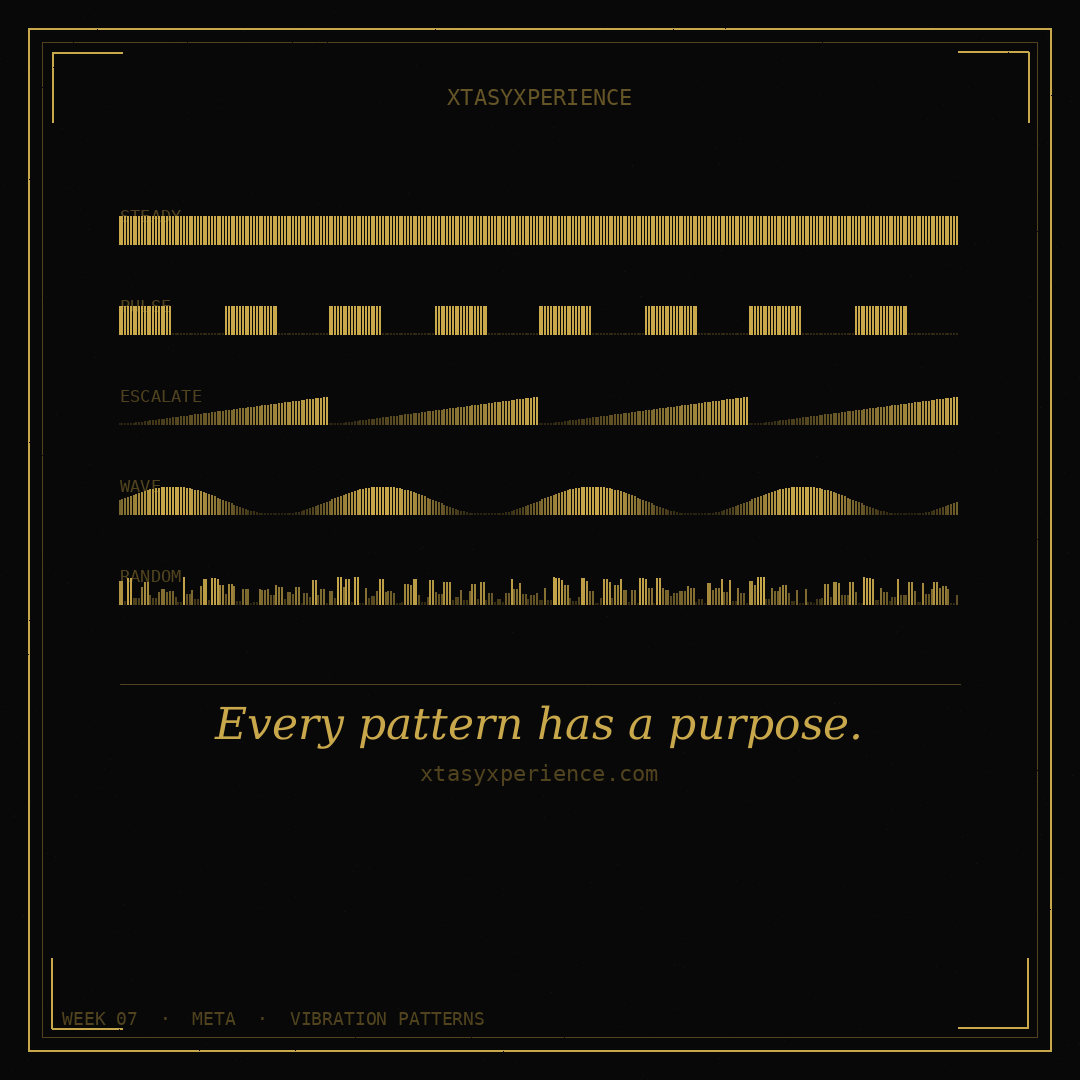
Vibration patterns exist for a reason — but most people never figure out how to use them well. Here's exactly what each pattern does and when to reach for it.
Most vibrators ship with somewhere between five and thirty vibration patterns. Most people use two of them: the lowest steady setting while they're finding their position, and the highest steady setting once they're there. The patterns in between — the pulses, waves, escalating rhythms — get cycled through once or twice and quietly ignored thereafter.
That's not a failure of curiosity. It's a failure of information. Patterns aren't decorative features — they're tools that serve specific physiological purposes. Using them well requires knowing what each one does to the body and when that's useful. This guide covers both. The complete vibrator buying guide covers the broader choice framework; this post goes deep on patterns specifically.
Why Vibration Patterns Exist — The Physiology
Your nervous system adapts to consistent stimulation. It's a feature, not a flaw — the mechanism that allows you to stop consciously registering the feel of clothing against your skin within minutes of getting dressed. The same adaptation applies to vibration: a continuous, unwavering stimulus delivered to the same point at the same intensity will produce diminishing returns over time as the nerve endings in the area adjust to it and reduce their firing rate.
Vibration patterns interrupt this adaptation. A pulse introduces a gap. An escalating rhythm changes the intensity. A wave moves the sensation profile rather than holding it static. Each of these variations requires the nervous system to reset its interpretation of what it's receiving — which means the stimulation continues to register as new rather than becoming background noise.
The practical implication
Patterns are most useful when you've been using a steady setting for several minutes and the sensation has started to feel less acute than it did initially. They're a recalibration tool — not a replacement for steady vibration, but a way to restore sensitivity when steady vibration has begun to dull it.
The people who find patterns useless are often using them at the wrong moment — as their primary stimulation mode from the beginning rather than as a response to adaptation partway through. Used in that sequence, many patterns that felt distracting become genuinely useful.
The Five Most Useful Patterns — and What Each One Does
Most of the patterns on any given vibrator are variations of these five. Understanding the category makes navigating a 20-pattern library far less arbitrary — and makes it easier to identify which type of pattern your body actually responds to rather than cycling through randomly and hoping.
Steady
Continuous vibration at a fixed intensity. Not technically a pattern, but functionally the most important setting on any vibrator. The baseline everything else is measured against. Use it first, use it most, and return to it when patterns stop working. The people who skip steady in favour of patterns immediately are almost always the ones who say patterns don't do anything for them — start here, every time.
Pulse
Rapid on-off cycling at a consistent interval. The most common pattern and, for many people, the most effective. The gaps in stimulation prevent nerve adaptation while maintaining a rhythmic quality that many people find easier to build toward orgasm with than continuous vibration. If you're going to try one pattern, try pulse first. The interval speed matters significantly — a fast pulse (close to continuous) produces a different sensation than a slow pulse (almost staccato).
Escalating
Intensity builds from low to high over several seconds, then resets. The build creates anticipation — a sensation arc rather than a static experience. Many people find escalating patterns more engaging than either steady or pulse because the variation happens over a longer time frame that the body can follow narratively rather than just respond to rhythmically. Most effective when the top intensity in the escalation is set above your usual working steady level.
Wave
Intensity rises and falls in a smooth undulating pattern rather than the sharp cuts of a pulse. The sensation is gentler and more continuous-feeling than pulse, and for people who find pulse interruptions distracting rather than useful, wave patterns often work where others don't. Think of it as a middle path between steady and pulse — the variation is there, but it doesn't break the sensation as abruptly.
Random / Custom
Unpredictable variations in intensity and timing. For some people, unpredictability is genuinely arousing — the inability to anticipate the next sensation creates a heightened state of attention. For others, it's just frustrating. This is the most personal of the pattern types and the most polarising. Worth trying; not worth using if it doesn't immediately feel interesting. It either works for you or it doesn't — unlike other patterns, this one rarely improves with familiarity.
The choice between wand and classic vibrator also affects how patterns feel, since the same pattern delivered over a broad surface produces a different character of sensation than delivered at a precise point. The wand vs. classic comparison covers that distinction if you're still at the toy-selection stage.
When Steady Beats Every Pattern
There's a persistent implication in vibrator marketing that a toy with more patterns is a better toy — that the person who uses the 20-pattern library is having a more sophisticated experience than the person who finds their steady setting and stays there.
This is not true. For many people, a consistent, well-chosen intensity delivered without interruption builds more reliably toward orgasm than any pattern sequence. The neural pathway to orgasm is, in part, about building a consistent signal rather than varying it. For these people, patterns are not a shortcut — they're a reset that requires starting the build over.
If you've used vibrators for some time and have never found a pattern that improves on your best steady setting, that's accurate self-knowledge, not a limitation. What it means for buying decisions: prioritise the quality and range of the steady motor over the quantity of patterns. A toy with exceptional steady vibration and four patterns will serve you better than a toy with mediocre steady performance and thirty patterns.
Patterns do become more relevant in partnered contexts — partly because introducing variation creates a shared experience of response rather than a solo pursuit. Using a vibrator with a partner covers how patterns fit into shared use specifically, including how partner-controlled pattern selection changes the dynamic.
A Practical Approach to Finding Your Patterns
Rather than cycling through a pattern library from the beginning of a session — which is how most people approach this and why most people decide patterns aren't for them — try this structure across two sessions.
Session one: Use only your best steady setting for the entire session. Don't touch the patterns. This gives you a clear baseline of what steady feels like at its best, and it lets you identify the exact point in the session when the sensation starts to feel less acute than it did initially. That point — the moment of adaptation — is where patterns are most useful.
Session two: Replicate session one until you reach the adaptation point, then switch to pulse. Notice whether the sensation refreshes or whether the interruption breaks something that was working. If it refreshes — stay with pulse and see where it takes you. If it breaks the build — try wave instead of pulse. Wave maintains more continuity than pulse and often works where pulse doesn't.
If neither pulse nor wave improves on returning to steady, you have useful information: you're a steady user, and your next toy should prioritise steady motor quality over pattern quantity. Find your ideal vibrator in our collection — filtering by motor quality and intensity range is the right starting point.
Put It Into Practice
Patterns are tools. Now that you know what each one does, you can use them when they serve you rather than cycling through them hoping one will click. Browse our vibrators collection — every product listing notes the pattern range so you can match what you've learned here to the toy that delivers it.