
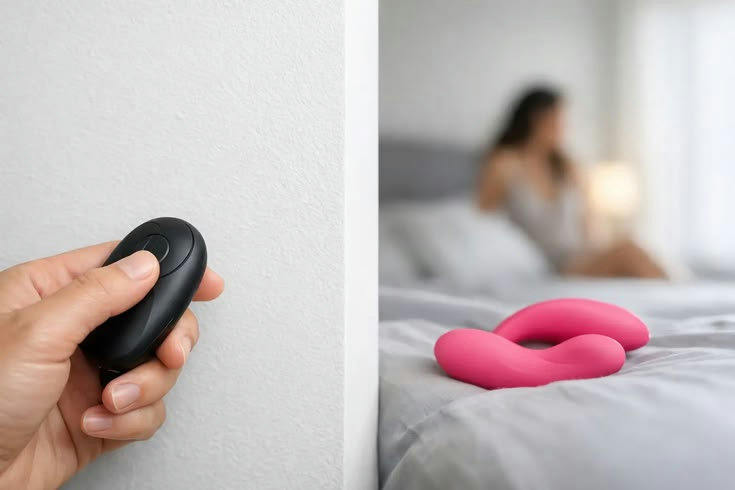
If you're wondering whether do remote vibrators work through walls is a yes-or-no question, the honest answer is less glamorous and more useful: sometimes. A remote vibrator can work perfectly from the next room, then struggle the moment a concrete wall, metal appliance, or crowded Bluetooth environment gets in the way. The difference usually comes down to the control technology, the layout of your space, and the quality of the toy itself.
That matters because remote play is supposed to feel effortless. Whether you're building anticipation at home, adding playful control to a date night, or choosing a discreet toy for long-distance intimacy, signal reliability shapes the entire experience. A beautiful design and strong motor only go so far if the connection drops at the wrong moment.
Do remote vibrators work through walls in real life?
Yes, many of them do - but not equally well, and not in every setting. A remote vibrator's ability to work through walls depends first on whether it uses a simple radio-frequency remote, Bluetooth, or app-based internet control.
Traditional handheld remotes often work well at short range and can sometimes pass through interior walls, especially drywall and wood. In a small apartment or house with standard construction, that may be enough for smooth control from one room to another. But range claims on packaging are usually measured in ideal conditions, not in homes filled with doors, mirrors, metal framing, routers, and other devices competing for signal space.
Bluetooth-controlled vibrators tend to be more limited when you're talking about walls and distance. Bluetooth is convenient and elegant for close-range control, but it's sensitive to obstacles. A toy that responds instantly in the same room may become inconsistent if the user moves behind multiple walls or farther down a hallway.
App-controlled toys are a different category. If the app uses your phone's internet connection rather than relying only on a local Bluetooth link, walls become much less relevant once the toy is paired properly. In that case, the issue is less about the wall itself and more about whether the device maintains a stable connection to the controlling phone or hub.
What affects whether a remote vibrator works through walls?
The biggest factor is signal type. Radio frequency can be surprisingly reliable over short indoor distances, while Bluetooth usually offers a more polished user experience but less forgiving range through barriers. App-connected toys can extend far beyond a room or a building, but they still depend on strong pairing and a stable network.
Wall material matters more than most people expect. Drywall is relatively easy for signals to pass through. Brick, concrete, tile, and metal are much tougher. If you're in a modern high-rise with reinforced walls, or an older building with dense construction, even a well-made remote toy may not perform the same way it would in a wood-frame home.
Room layout also changes the result. A straight path through one wall is different from a signal trying to travel around corners, past kitchen appliances, and through a bathroom door. Add in a phone in a back pocket or buried inside a bag, and the connection can weaken further.
Then there's build quality. Premium remote vibrators often have better internal antennas, more consistent software, and stronger pairing protocols. That's part of what you're paying for in a luxury category - not just aesthetics, but fewer frustrating interruptions during play.
Bluetooth vs remote vs app control
If your goal is reliable performance through walls, these categories are worth understanding before you buy.
Handheld remote control
A classic remote-controlled vibrator is often the simplest option. You have a dedicated remote and a toy that receives that signal directly. This can feel intuitive and discreet, especially for couples exploring playful control at home or in semi-private settings.
The upside is simplicity. The downside is variability. Some handheld remotes work impressively well through one or two interior walls, while others become inconsistent much sooner. Results vary widely by brand and construction quality.
Bluetooth control
Bluetooth models are elegant because they let a smartphone act as the controller. That usually means better pattern customization, smoother interface design, and easier intensity adjustments. For same-room or close-range use, Bluetooth can feel refined and responsive.
Where it gets less ideal is when walls enter the equation. Bluetooth generally wasn't designed to be a through-the-house solution. If your vision is controlling a toy from the far side of the home, Bluetooth-only products may feel limited.
App-controlled vibrators
For distance and flexibility, app-enabled toys are usually the strongest choice. Many premium models pair locally via Bluetooth at first, then allow broader control through an app connection. That opens the door to partner play across rooms, cities, or even states, depending on the product.
If you're choosing for long-distance intimacy or more reliable control beyond one room, app-supported designs usually offer the best experience. They're also often the most feature-rich, with custom patterns, touch controls, and shared access options.
How far can a remote vibrator work through walls?
There is no universal number that means much once you're inside a real home. A listing might say 30 feet, 50 feet, or more, but that doesn't guarantee performance through multiple rooms. Think of range claims as a best-case scenario, not a promise.
In practice, many decent remote vibrators perform well in the same room and reasonably well through one interior wall. Beyond that, reliability becomes more situational. A high-end app-controlled toy may outperform a basic remote at greater distances, but only if the setup is strong from the start.
This is why shoppers who care about control dynamics, discretion, or planned partner play should look beyond the headline range number. The more useful question is how the toy performs in your kind of environment.
How to get better performance through walls
A few small choices can improve reliability significantly. Keep the controlling phone or remote unobstructed rather than tucked inside heavy clothing or a crowded bag. Pair the toy in the same room first, then test movement gradually. If the toy uses an app, make sure both the app and device firmware are updated.
It's also smart to reduce interference where possible. Wi-Fi congestion, other Bluetooth devices, and physical barriers can all chip away at signal strength. If a toy feels inconsistent, moving closer or changing rooms may solve the issue faster than assuming the product is defective.
And if through-wall performance is central to your experience, choose for that purpose from the beginning. A toy designed for elegant app control or stronger remote functionality will serve you better than a minimalist budget model built mainly for close-range use.
What to look for before you buy
If you're shopping with intention, product details matter. Look for whether the toy is Bluetooth-only, handheld remote-controlled, or app-enabled for extended distance. Read how the brand describes real-world control, not just ideal range claims.
Design still matters, of course. Comfort, noise level, motor quality, and materials all shape the experience. But with remote toys, connection reliability deserves equal attention. A beautifully finished vibrator that loses signal easily won't feel especially luxurious in use.
This is where a curated retailer can make the process easier. At XtasyXperience, the remote-control category is part of a broader intimacy-forward approach that helps shoppers choose by scenario and experience, not just specs. For buyers who want refined pleasure with less guesswork, that framing matters.
So, do remote vibrators work through walls?
They can, and many do, but the better question is how well they work through your walls. Drywall in a compact space is one thing. Brick, concrete, steel, and long hallways are another. Bluetooth may be enough for close connection, while app-enabled control is usually the stronger choice for more range and fewer limitations.
If you want the experience to feel polished, choose a remote vibrator the way you would choose any luxury essential - by looking at performance, design, and context together. A little selectivity upfront leads to better control, better confidence, and a far more satisfying kind of anticipation.